

When snow becomes dangerous: understanding heavy snowfall
Switzerland is no stranger to heavy snowfall. But when an unusually large amount of snow falls in a short time, it can cause serious problems across the country. The national risk analysis Disasters and Emergencies Switzerland (DES) 2025, published by the Federal Office for Civil Protection (FOCP), takes a close look at what such an event means for people, infrastructure and essential supplies.
What can happen?
When snow keeps falling, the country starts to grind to a halt. Rail lines and airports face disruption, and roads get shut down — not just in the mountains, but across the Swiss Plateau too (Figure 1). The weight of accumulated snow puts roofs, trees and infrastructure under serious stress. The results: collapses, roof avalanches, falling trees. Power lines and communications infrastructure are equally vulnerable — when they fail, outages can follow quickly.
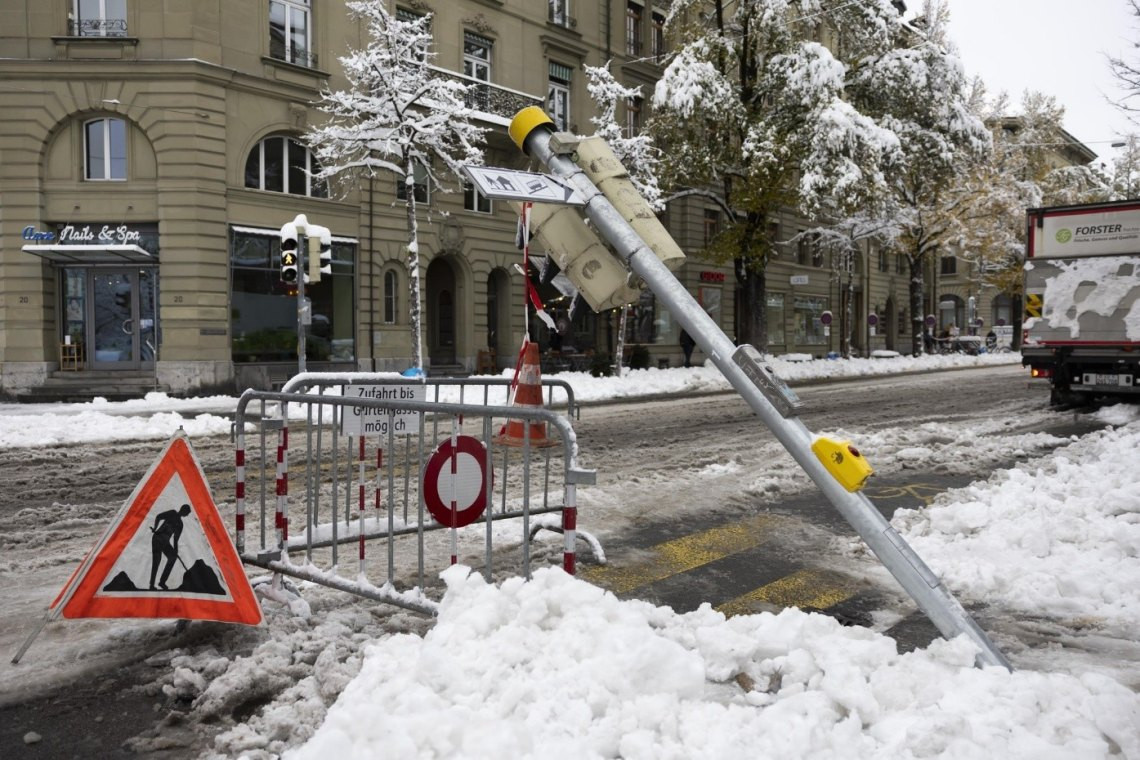
When the snow won’t stop – a possible scenario (DES 2025)
An already snowy winter takes a turn for the worse in mid-February, when a stationary front pushes large amounts of moist air in from the Atlantic. Over three days, the Swiss Plateau is buried under 50 to 70 cm of fresh snow — in some places up to 80 cm. Strong gusts drive additional drifting.
Clearance teams work around the clock, but the situation deteriorates faster than they can keep up. Secondary, roads become impassable and even motorways are reduced to a single lane. One by one, municipal, regional and cantonal emergency management teams are activated. Civil defence units are deployed and the army is called in to help. It isn’t enough — after about two days, traffic grinds to a complete standstill in many areas. Thousands of people are stranded in their vehicles and have to be evacuated over the following three days, with civil defence facilities, gymnasiums and other venues pressed into service as emergency shelters.
Meanwhile, falling trees and the sheer weight of snow bring down power lines and antennas, cutting electricity and telecommunications in affected areas. Difficult conditions on the ground and poor visibility in the air make repairs slow and helicopter rescue all but impossible.
Emergency call centres are overwhelmed by reports of accidents and missing persons, while rescue teams struggle to reach those in need. After two days, the effects begin to be felt in shops — supply chains are disrupted, shelves start to empty and panic buying makes things worse.
After three days, the snow stops and a high-pressure system moves in. Temperatures drop and stay below freezing. The immediate crisis eases, but recovery is slow: large stretches of the Swiss Plateau remain under 50 to 80 cm of snow, transport routes stay blocked and some buildings remain at risk of collapse.
The turning point comes quietly — clearance teams begin making rapid progress and most roads are reopened within two days of the snowfall ending, quickly easing the shortage of goods. Damaged power and telephone lines are provisionally repaired within three days and life, gradually, returns to normal.
Impact on the society, the environment and the economy (DES 2025)
Heavy snowfall leads to a significant increase in traffic accidents. Numerous people are injured or rescued from stranded vehicles, many suffering from hypothermia. The weight of accumulated snow can also cause roofs to collapse, putting lives at risk. Poor road conditions make emergency medical care considerably more difficult, while limited visibility often makes air rescue impossible.
The economic and infrastructure impacts are equally severe. Road, rail and air traffic are heavily disrupted, while damage to buildings, power outages and telecommunications failures affect businesses and supply chains alike — creating bottlenecks in the supply of everyday goods, food and medicines. In the DES 2025 scenario, total material damage is estimated at around 350 million Swiss francs.
How the DES scenario supports emergency response organisations
The DES scenario on heavy snowfall gives the federal government, cantons and municipalities a concrete basis for civil protection planning. Rather than preparing for vague worst cases, emergency response organisations can use it to stress-test specific vulnerabilities — critical infrastructure, resource gaps, coordination between agencies.
When an event actually unfolds, the scenario helps management teams quickly assess the situation, prioritise measures and work across organisational boundaries without losing time to ambiguity.
And once the snow stops, it serves as a guide for restoring infrastructure and coordinating clean-up and recovery — the phase that often gets less attention but matters just as much.
What can you do?
Knowing how to behave during heavy snowfall can make a real difference — for your own safety and that of those around you. A few guidelines that always apply:
- Stay away from trees and roofs — falling branches, breaking trees and roof avalanches are serious hazards.
- If avalanche danger is high, stay indoors and close shutters on the uphill side and exposed sides of the building.
- Stay informed and follow the instructions of local authorities.
Depending on how the situation develops, further guidance may be issued. The most reliable source remains official channels — local authorities, radio broadcasts and alert apps such as Alertswiss.
It also helps to be generally prepared before an emergency strikes. A basic household supply — drinking water, food that keeps, essential medicines and a camping stove or gas cooker — can make a significant difference if you’re snowed in or supply chains are disrupted for a few days. It’s a small investment that pays off well beyond winter.
More information
- Full details on the topics covered in this article can be found in the hazard dossier Heavy Snowfall (currently available in German, French and Italian).
- For recommendations on emergency supplies, first aid kits, emergency accommodation and emergency luggage, see the Emergency Plan on Alertswiss.
- Information on other hazards is available in the Know your hazards section.
- For guidance on heavy snowfall, frost and icy roads — including current warnings — visit the Natural Hazards Portal.
- For weather forecasts and situation updates, see MeteoSwiss.
This article was written by the ‘National Risk Analysis’ team at the Federal Office for Civil Protection (FOCP).


