
The National Risk Analysis – Disasters and Emergencies in Switzerland (DES) 2025
The national risk analysis DES examines a broad spectrum of hazards and risks relevant to civil protection. The latest update drew on expertise from 265 specialists spanning government, industry, and research and identifies pandemics and power supply shortages as the top current risks in Switzerland. Encouragingly, proactive measures have contributed to effectively minimise risks in several critical areas.
What is the National Risk Analysis DES?
Recent years have delivered a stark reminder of how vulnerable societies can be. Pandemics, cyberattacks, power outages, and floods have tested the resilience of societies worldwide—and Switzerland is no exception. The country faces a complex and evolving landscape of potential hazards and threats. That’s why the Federal Office for Civil Protection FOCP conducts comprehensive risk assessments through its national risk analysis Disasters and Emergencies Switzerland (DES). This systematic evaluation examines natural, technological and societal hazards that could impact the country.
To stay aligned with an evolving risk landscape—shaped by climate change, emerging technologies, and shifting geopolitical dynamics—the analysis is refreshed every five years. The newly released DES 2025 identifies pressing current and future risks while underscoring the critical importance of preparedness.
Mapping Switzerland’s hazard landscape
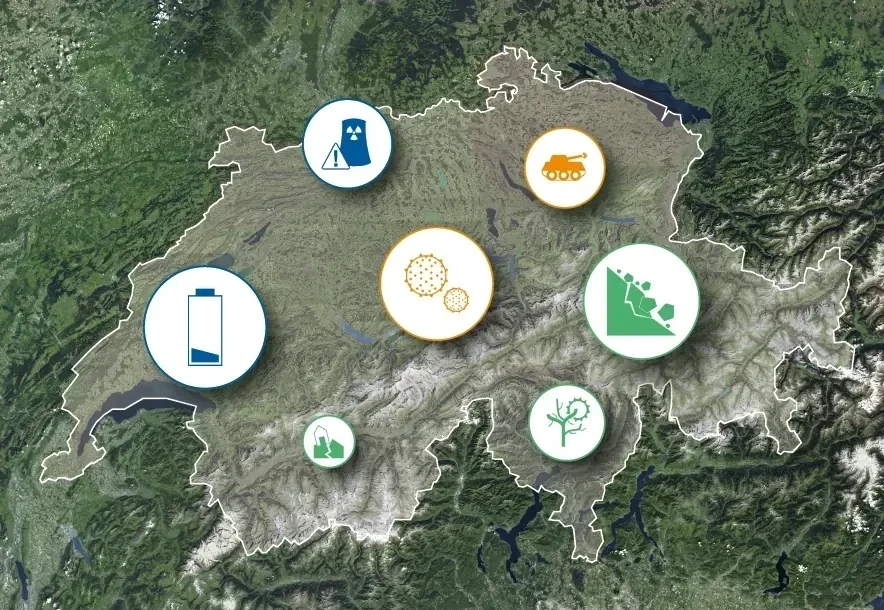
The national risk analysis DES 2025 examines a total of 44 hazards relevant to civil protection, each analysed through detailed scenarios. The hazards span three key domains:
- Nature: Heat waves, floods, earthquakes, droughts, rockfalls, etc.
- Technik: Power outages, nuclear power plant incidents, gas shortages, etc.
- Gesellschaft: Pandemics, cyberattacks, terrorist attacks, armed conflict, etc.
Each of the 44 hazards received its own comprehensive dossier, including foundational information—definitions, risk factors, past incidents— alongside a detailed potential scenario.
In partnership with experts from government, business and research, these scenarios were refined and assessed for their likelihood or plausibility and their potential impact across four domains: individuals, environment, economy and society. Twelve damage indicators collectively measure the full scope of potential damage, encompassing everything from fatalities to critical supply shortages.
Switzerland’s top risks
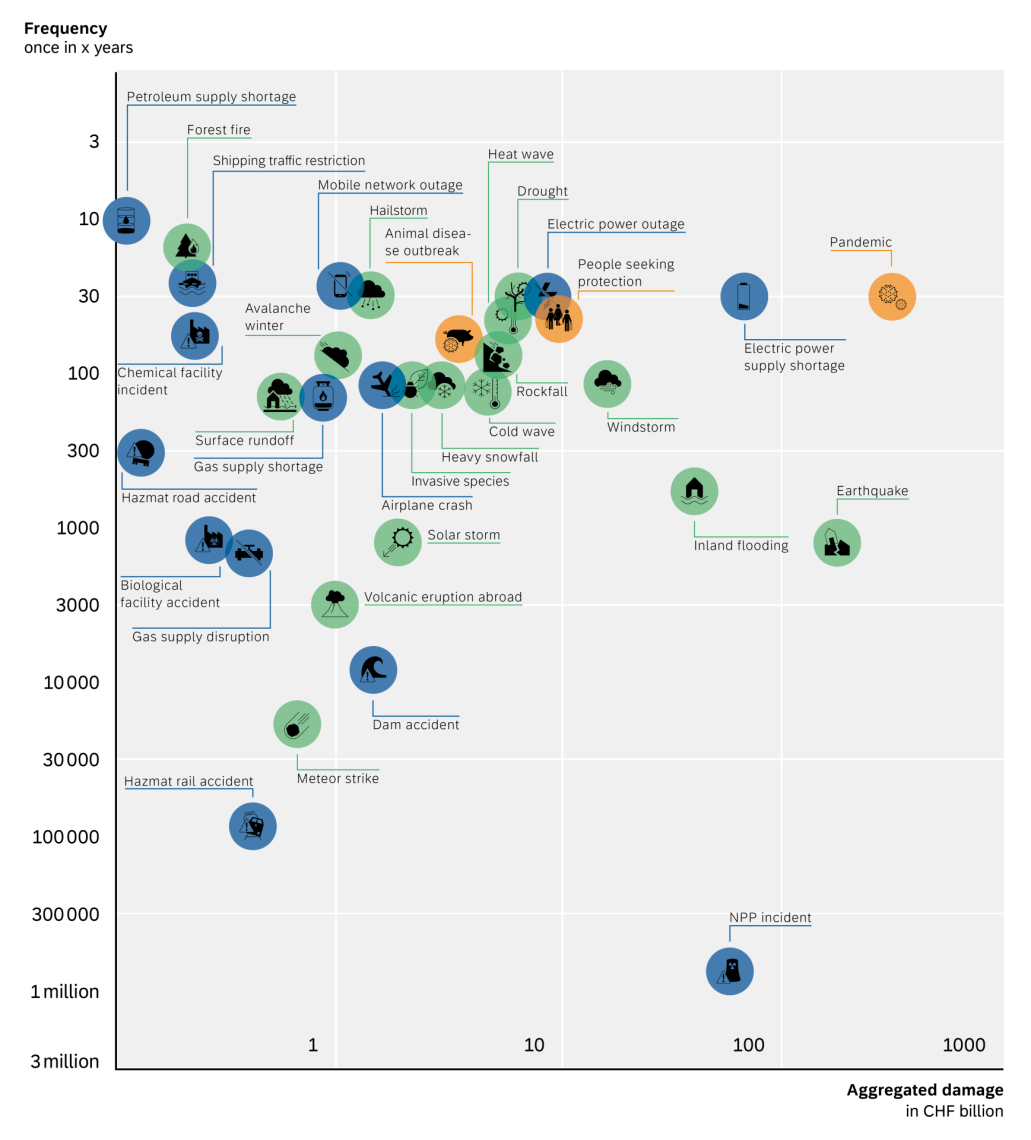
The findings are clear — risk isn’t just about impact or likelihood alone, but the combination of both. According to DES 2025, the highest-risk scenarios are:
- Pandemics
- Electric power supply shortages
- Mass influx of people seeking for protection (1)
- Electric power outages
- Droughts
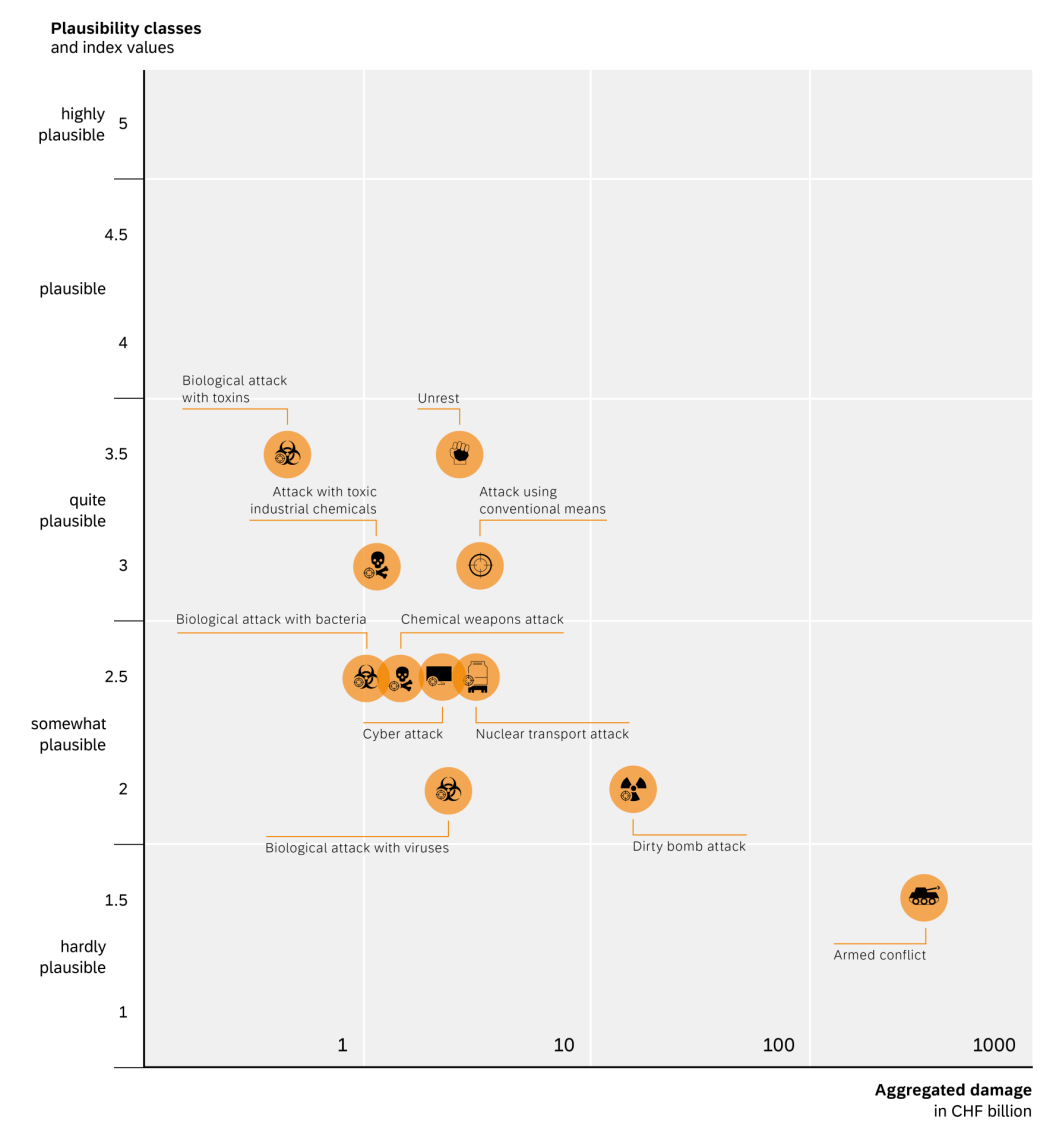
Other hazards such as armed conflict, earthquakes and nuclear power plant incidents also warrant serious attention. While they rank lower in overall risk due to their infrequent occurrence, their potential for catastrophic damage makes them critically important. Figures 1 and 2 show the risk matrix for all non-malicious and malicious hazards respectively. For a deeper dive, explore individual hazards through the interactive risk matrices online.
Find out more about DES 2025
We’ve developed several resources to help you engage with the DES 2025 national risk analysis:
- Risk brochure: This accessible overview, designed for the general public, presents the national risk analysis and highlights its key findings and practical applications.
- Risk report: The comprehensive technical report contains detailed analytical results, serving as the foundation for strategic planning and informed decision-making.
- Collection of hazard dossiers (2): Each of the 44 examined hazards has its own dedicated dossier with detailed scenarios.
- Hazard catalogue: A complete inventory of all civil protection-relevant threats that could potentially occur in Switzerland or significantly impact the country.
- Methodology report: An in-depth explanation of the DES analytical approach and risk assessment methods.
For more Information and a summary of key findings please visit our website: www.risk-ch.ch
(1) The FOCP does not classify people seeking protection as a risk. However, managing large influxes presents a capacity challenge, requiring civil protection partners to rapidly scale up accommodation, food distribution, medical care, and other essential services.
(2) The collection of hazard dossiers have not been translated into English but are available in three languages: German, French and Italian.


