
National Risk Analysis DES 2025 – Societal hazards
Pandemics, mass refugee movements, social unrest or terrorist attacks can profoundly reshape life in Switzerland. The national risk analysis Disasters and Emergencies Switzerland (DES) 2025 identifies societal hazards among the most complex risks facing Switzerland. This blog post explores what these risks involve and why preparedness, solidarity and trust are crucial to overcoming crises together.
Societal risks affect our daily lives
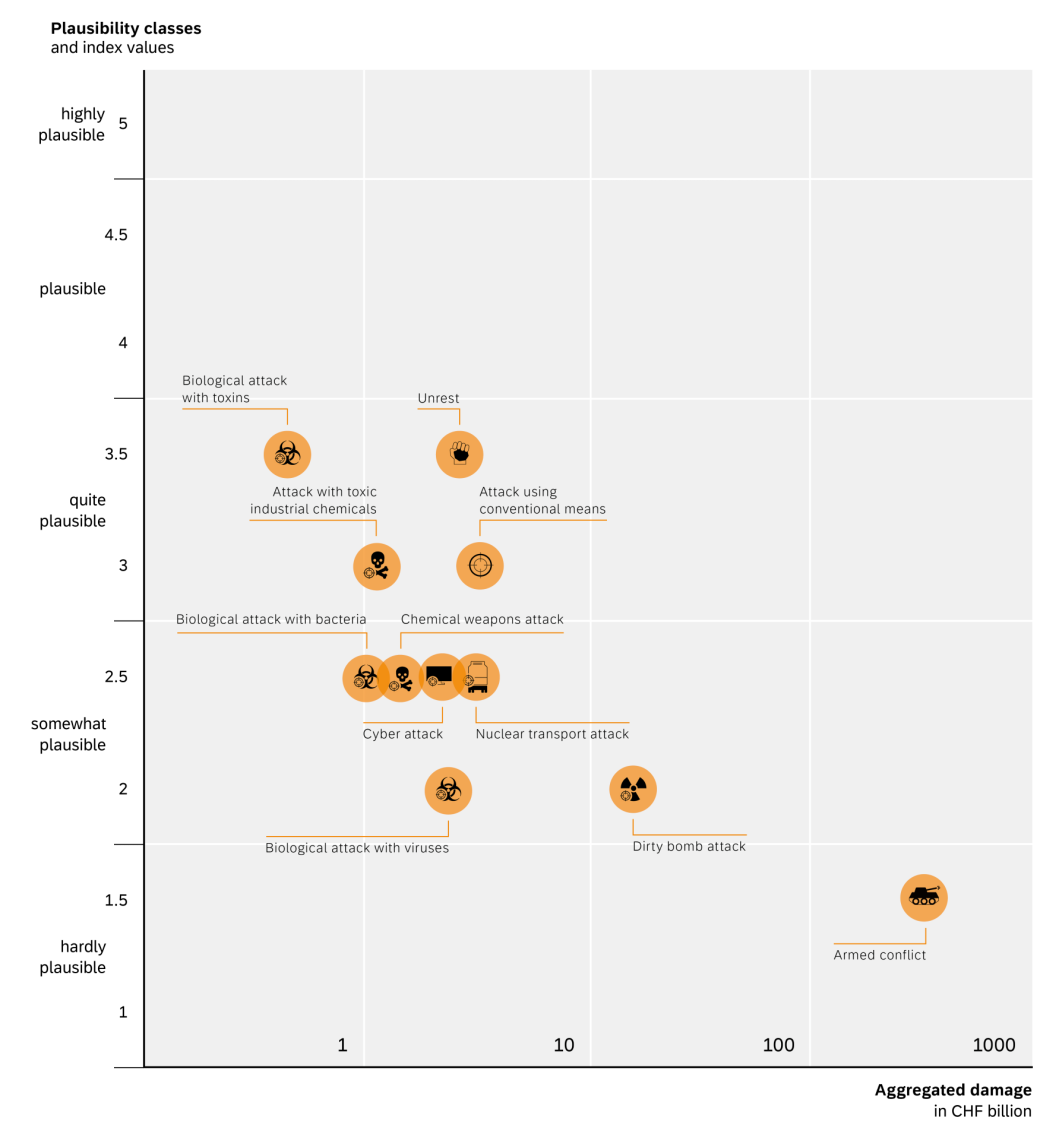
Societal risks are often less visible in public debate than natural or technical hazards, yet their effects reach deep into everyday life. DES 2025 examines scenarios ranging from pandemics and large-scale refugee movements to civil unrest and terrorist attacks and finds that such events can seriously undermine social cohesion, security of supply and trust in state institutions (see Figure 1). They can unfold rapidly and are frequently made worse by interactions between hazards.
While societal risks cannot be prevented entirely, their impact can be substantially reduced. Prepared authorities, clear responsibilities and well-rehearsed crisis procedures are essential — as is an informed public. People who know where to find reliable information and are willing to take responsibility and cooperate with others make a vital contribution to crisis management.
Lessons from past crises
The COVID-19 pandemic demonstrated just how profoundly societal risks can affect all aspects of life — from our health and the economy to education, work, social interaction and mental wellbeing. DES 2025 shows that similar pressures may arise in future, particularly when large numbers of people need support simultaneously and public authorities, the healthcare system and social services are overstretched.
Such situations can be exacerbated by uncertainty, fear and conflicting information. Transparent communication, clear decision-making and solidarity are needed to maintain social cohesion and trust in government and its institutions – key foundations of a stable society.
Geopolitical tensions as a source of new threats
The war in Ukraine has fundamentally altered the security landscape in Europe. It has also made clear that modern conflicts extend well beyond the battlefield — cyberattacks, disinformation, economic coercion and political interference are all part of modern hybrid conflicts. Switzerland is not insulated from these dynamics. Highly interconnected and home to many international organisations, as well as host to critical infrastructures with cross-border significance, it is exposed to geopolitical turbulence — as evidenced by rising energy prices, refugee movements, and inflation.
The risk of hybrid or armed attacks on Switzerland has grown. Switzerland is therefore reinforcing its defence and civil protection capabilities, involving not only the military but all civil protection partners and improving coordination between authorities and emergency services.
DES 2025 explores a scenario in which hybrid attacks escalating to military force can cause casualties, could severely disrupt critical supplies and services and fundamentally impact domestic security and daily life (see Figure 2). The scenario is not a prediction — it is a planning tool, designed to sharpen awareness and strengthen Switzerland’s readiness for potential crises.
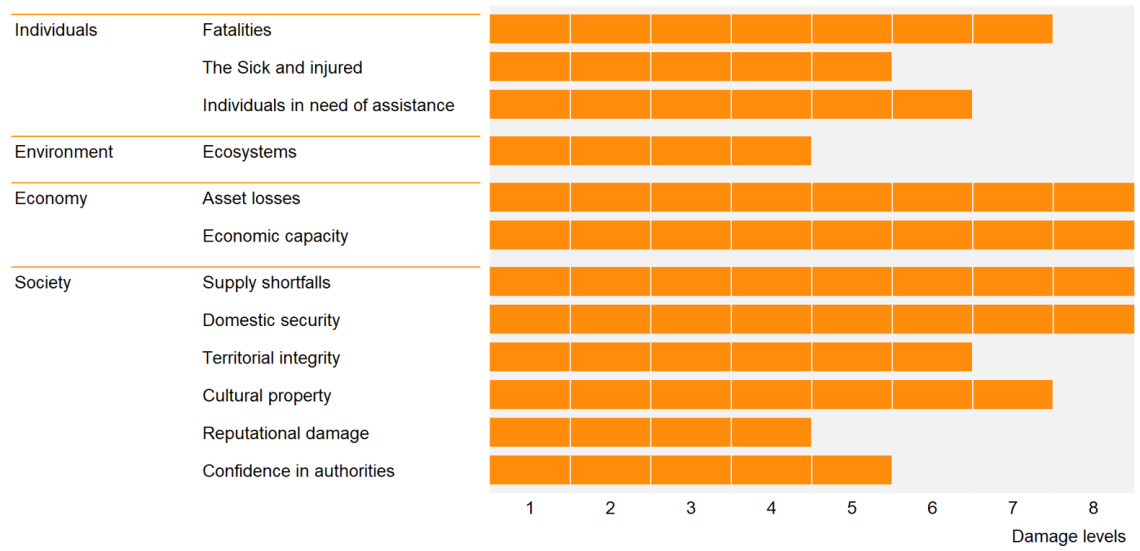
Figure 2: Damage assessment diagram for the scenario “armed conflict”, involving both a hybrid preliminary phase and a full military escalation. The consequences are far-reaching across all sectors of society and require a coordinated response between the military and civil protection services.
Conclusion: DES 2025 as a shared framework
The DES 2025 national risk analysis helps the federal government, cantons and municipalities to better identify potential hazards and prepare for them. But a resilient Switzerland is not built by public authorities alone. Every individual can contribute — by staying informed, taking precautions and supporting others in difficult situations. Solidarity and trust are not abstract values; in times of crisis, they are practical necessities. The better prepared individuals are, the more resilient Switzerland as a whole becomes — and the better equipped to manage societal risks.
Click here to find out how you can prepare for hazards and risks.
This article was written by the ‘National Risk Analysis’ team at the Federal Office for Civil Protection (FOCP).


