
Drought – When water becomes scarce
Even in Switzerland, often described as Europe’s “water tower”, climate change could lead to increasing water shortages and droughts. Low precipitation and high evaporation can create a water deficit, which can lead to drought over an extended period. Depending on the season, the environment and agriculture already begin to feel the negative effects of below-average precipitation after just one to three months, while the energy sector and water supply are only affected during longer periods.
When does a drought occur?
The intensity and duration of dry periods depend on precipitation deficit, evaporation and the overall conditions leading up to a dry period such as soil moisture, the water levels of lakes, rivers and groundwater levels and the volume of snow and glaciers (water reservoirs). Drought can also be exacerbated or caused by increased water demand (households, industry, and agriculture).
Soil moisture is particularly important for the environment and agriculture. Water levels and discharge volumes are particularly important for agricultural irrigation, navigation and shipping as well as energy production. For drinking water supply, on the other hand, the groundwater level is crucial. A particularly severe drought typically can affect a large region (e.g., all of northern Switzerland and neighboring countries).
Drought often occurs in conjunction with heat waves or high temperatures. However, it can also occur independently of these – even in winter – or persist after a heat wave has ended. Furthermore, drought, especially when combined with heat and wind, increases the risk of wildfires. Navigation on the Rhine can also be disrupted by prolonged drought due to low water levels.
For more details on a possible drought scenario and expected impacts, please refer to the hazard file of the national risk analysis “Disasters and Emergencies in Switzerland.
A look into the future: more rain-free days in summer
Although Switzerland is often considered the “water tower of Europe,” climate change is leading to increasingly frequent summers with little rain and winters with little snow. Additionally to less rain, the higher temperatures are causing more moisture to evaporate than before. The soil is becoming drier, even during periods with the same total precipitation. With the retreat of glaciers and the snowpack, important water reservoirs are also being lost – reservoirs that previously supported runoff and water levels in spring and summer. Since a decline in precipitation is expected during the summer months in the future, the effects of drought will be felt more acutely.
For more information on future developments, visit: Drier summers – MeteoSwiss.
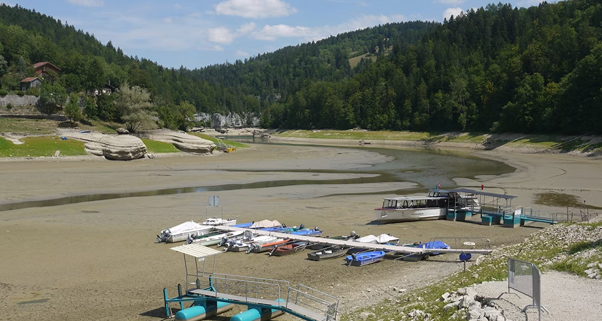
An example from Switzerland: The persistently high temperatures and drought during the summer of 2022 led to low water levels, warm water and a high risk of wildfires. Water levels in major rivers such as the Aare, Limmat, Reuss and Rhine were significantly below average. Water levels in many lakes were lower than usual for the summer months.
Potential Impacts
Drought was identified in the DES 2025 national risk analysis as one of the top five greatest risks facing Switzerland – due to its relatively high probability of occurrence and due to the significant damage it can cause. The consequences of a drought can be diverse and affect various aspects of life.
The public drinking water supply can be maintained almost everywhere in Switzerland thanks to water distribution networks and the use of tanker trucks. However, the usual standard of living cannot always be guaranteed and local or cantonal authorities may restrict water use, for example through bans on car washing or garden watering. Dry soils also increase the levels of particulate matter and pollutants in the air, deteriorating air quality. This poses an additional health burden, particularly for people with severe asthma or other respiratory diseases.
In addition, environmental damage is also likely. Large parts of Switzerland’s forests and other ecosystems can suffer from drought. The damage to forersts may also impair their protective function over the long term [Protection forest]. Ecosystems along standing and flowing waters can be severely affected. In some cases decimating fish populations or forcing authorities to organise emergency fish relocations, salvage or harvests.
The economy, particularly agriculture and shipping, is severely affected. Low soil moisture leads to crop failures and additional costs for purchasing roughage and irrigation. Depending on irrigation needs, cantons may, in turn, have to increasingly impose bans on water withdrawals for agricultural irrigation due to low water levels in flowing water bodies. Low river levels and rising water temperatures also reduce electricity production at river power plants by up to 25% during a drought. Navigation on the Rhine is also regularly affected by low water levels; inland container ships can only navigate safely with a reduced cargo load, leading to supply shortages.
For more information on the impacts, have look at the DES Hazard File Drought or visit the PLANAT website, or the national drought platform.
Behavioral recommendations for the general public
Drought is a creeping and often underestimated natural hazard. Meteorological conditions play a major role. However, it is still possible to prepare for a drought and take the right action if one occurs:
Before the event
- Check the current drought situation in your region on the national drought platform.
- Use water sparingly.
During a drought
- Check the national drought platform.
- Use water sparingly.
- Follow instructions from local authorities.
- Check the local danger situation if you plan to light a fire outdoors (Current danger situation).
After the event
- The risk of wildfires may still exist. Check the www.waldbrandgefahr.ch/en.
What can the government do?
To better prepare for drought, civil protection agencies can make use of the Drought Resilience Toolkit developed by the Center for Security Studies at ETH Zurich. A key action point is the development and integration of a national early warning system for drought, which is provided by the national drought platform of the federal government (FOEN, MeteoSwiss, swisstopo). The Drought Platform provides information on early detection (monitoring and forecasting) and warnings for the whole of Switzerland.
Another example of these action points are drought exercises such as the “Drought” tabletop exercises, which were first conducted in 2024 and are now available to the cantons through the Federal Office for Civil Protection (FOCP).
Picture: Lac des Brenets – 28.07.2022: Due to low water levels, boat service on Lac des Brenets (NE) had to be suspended on July 14, 2022. – © Edith Oosenbrug/FOEN [Summer 2022: heat wave and drought].
This article was written by the ‘National Risk Analysis’ team at the Federal Office for Civil Protection (FOCP).


