

The National Risk Analysis DES 2025 – Technological Hazards
Electricity, heating, the internet, mobile phones — many of the things we take for granted depend on functioning infrastructure. But what happens when these systems fail? The national risk analysis Disasters and Emergencies Switzerland (DES) identifies technical disruptions such as power cuts and energy shortages amongst the most significant risks facing the country. This blog post explains why these risks affect us all — and why preparation matters.
When the lights go out: Switzerland’s technological vulnerabilities
Modern society depends heavily on technical systems. Electricity flows from the socket, mobile networks keep people connected, goods arrive within days, and critical processes run quietly in the background. Yet the more we rely on these systems, the more exposed we become when they fail. The national risk analysis DES 2025 sets out which technical hazards now rank amongst the key risks facing the population, the economy and the state.
Technological hazards: complex dependencies
Technological hazards can have different origins. Some stem from internal failures — an IT error, a mechanical fault, human mistakes. Others are triggered externally — a storm knocks out the power grid, a cyberattack disrupts critical systems or an earthquake damages key infrastructure.
What makes technological hazards particularly challenging is that disruptions rarely stay contained. A power cut, for instance, can quickly cascade into failed communications, stalled logistics and disrupted supply chains. These chain reactions make technological risks so difficult to anticipate and manage.
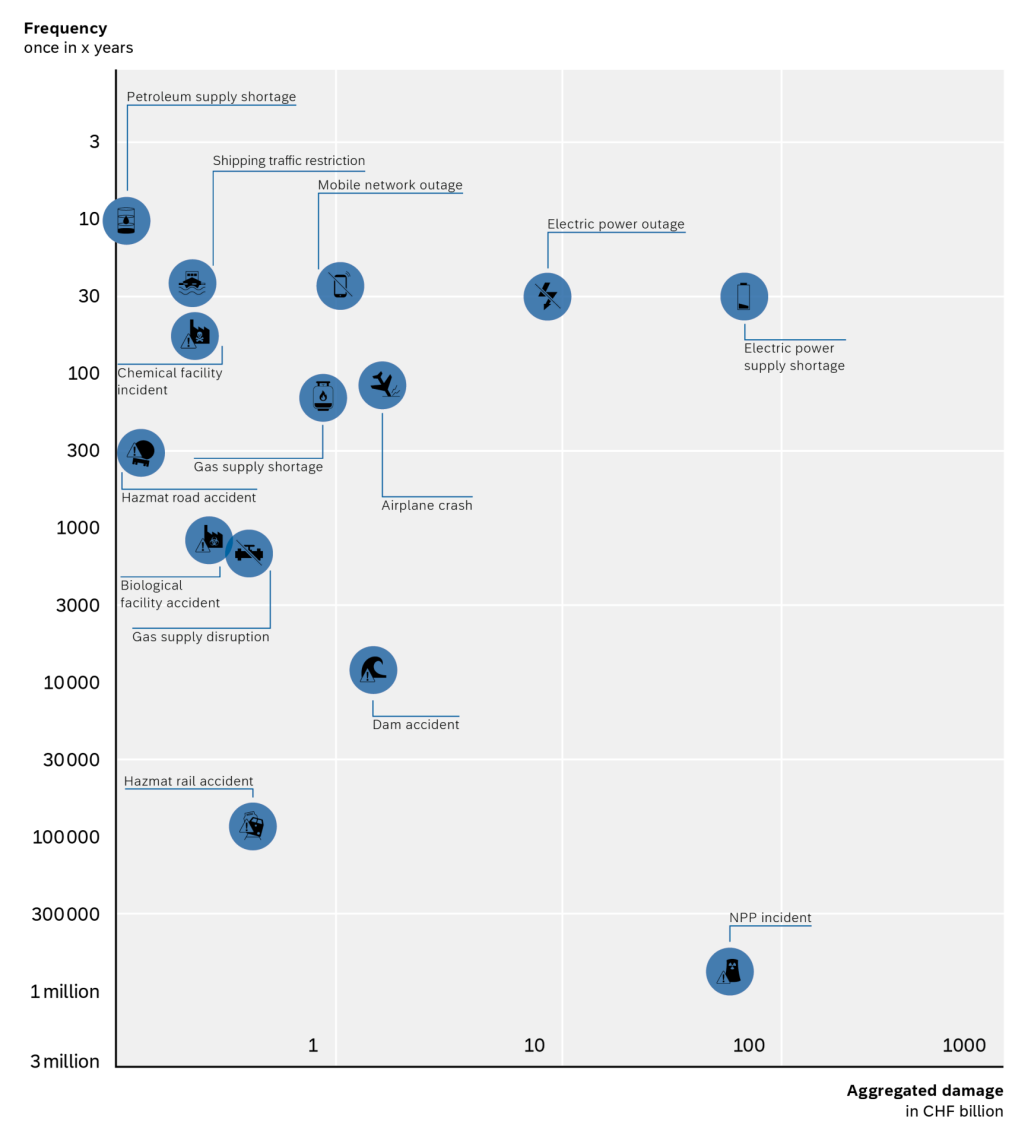
DES 2025 examines a wide range of such scenarios, including failures of energy and communications networks, supply shortages, industrial accidents and disruptions to transport and logistics systems (see Figure 1).
Energy supply: where are the risks?
Energy supply is one of the cornerstones of modern society. DES 2025 identifies electric power supply shortages and power outages amongst the greatest technological hazards facing Switzerland. Widespread blackouts are rare, but their impact is massive — as the power failure across Spain and Portugal in April 2025 demonstrated. Within hours, drinking water supply, payment systems and healthcare were all affected.
Supply shortages of natural gas and petroleum products are also classified as significant risks. Recent years have shown how quickly international dependencies, geopolitical tensions and market shifts can threaten security of supply. Mandatory stockpiles of petroleum products and precautionary measures for natural gas help mitigate the immediate effects, but prolonged shortages can have far-reaching economic and social consequences.
Critical infrastructure under pressure
Technological hazards extend well beyond the energy system. Telecommunications networks, transport routes and dams are all considered critical infrastructure — systems whose failure can have consequences far beyond their immediate function. A mobile network outage, for instance, may seem like an inconvenience, but can quickly undermine emergency communications and crisis coordination. Restrictions on shipping along the Rhine, meanwhile, affect supply chains for goods and raw materials that much of the economy depends on.
Incidents at industrial, chemical and nuclear facilities present a different kind of challenge. Accidents at such sites are rare, but their damage potential is very high. The same applies to accidents involving hazardous goods in transit. Even where extensive preventive safety measures are in place, these scenarios must be factored into contingency planning.
Interconnectedness as a risk: cascades and multiple crises
Technical hazards rarely occur in isolation. A power cut can trigger communication failures. Restrictions on shipping along the Rhine can disrupt the supply of petroleum products. Each disruption creates pressure elsewhere. In a highly interconnected society, failures that begin in one system can rapidly spread across others, affecting the economy, public services and everyday life — and creating the risk of multiple crises unfolding simultaneously.
Conclusion: building resilience before the crisis hits
Technical risks cannot be eliminated — but their impact can be significantly reduced. Robust systems, sufficient redundancies, clear responsibilities and thorough preparation are all essential. As DES 2025 makes clear, the greatest risks often do not arise from spectacular individual events, but from the interaction of complex, tightly interconnected systems. The analysis provides a common framework for the federal government, cantons, municipalities and operators of critical infrastructure to plan on a shared, comparable basis. A resilient Switzerland requires not only modern technology, but also forward-looking planning, regular exercises and a risk culture that is genuinely embedded across all levels of society.
This article was written by the ‘National Risk Analysis’ team at the Federal Office for Civil Protection (FOCP).


